
RYAN MELANSON
Small parts, big potential for 3D printing at FMF Cape Scott
By Ryan Melanson,
Trident Staff
Additive manufacturing technology is beginning to find its footing in naval maintenance and training work at Fleet Maintenance Facility (FMF) Cape Scott, where personnel are exploring the use of 3D printing for applications ranging from replacement components to detailed ship models.
SUBMITTED
Though the technology is not intended for large-scale repairs or recreating major pieces of naval equipment, it has already proven useful in a range of practical situations. Simple items such as deck caps, connectors, brackets, and even toilet paper holders have all been produced using FMF Cape Scott’s polymer and metal 3D printing capabilities.
Lieutenant-Commander Matthew Robbins, Naval Architecture Officer with FMF Cape Scott Engineering, noted the unit began introducing additive manufacturing capabilities in 2014.
“This includes the use of laser additive manufacturing systems for component repair (e.g., shaft restoration) and broader 3D printing applications within machine shops,” he said.
“The capability has expanded to include both polymer and metallic additive processes, with continued procurement and integration of new systems.”
Though technology is still emerging as part of FMF’s toolkit, and not yet standardized across production workflows, it is being used in support of maintenance and repair activities when possible, he added.
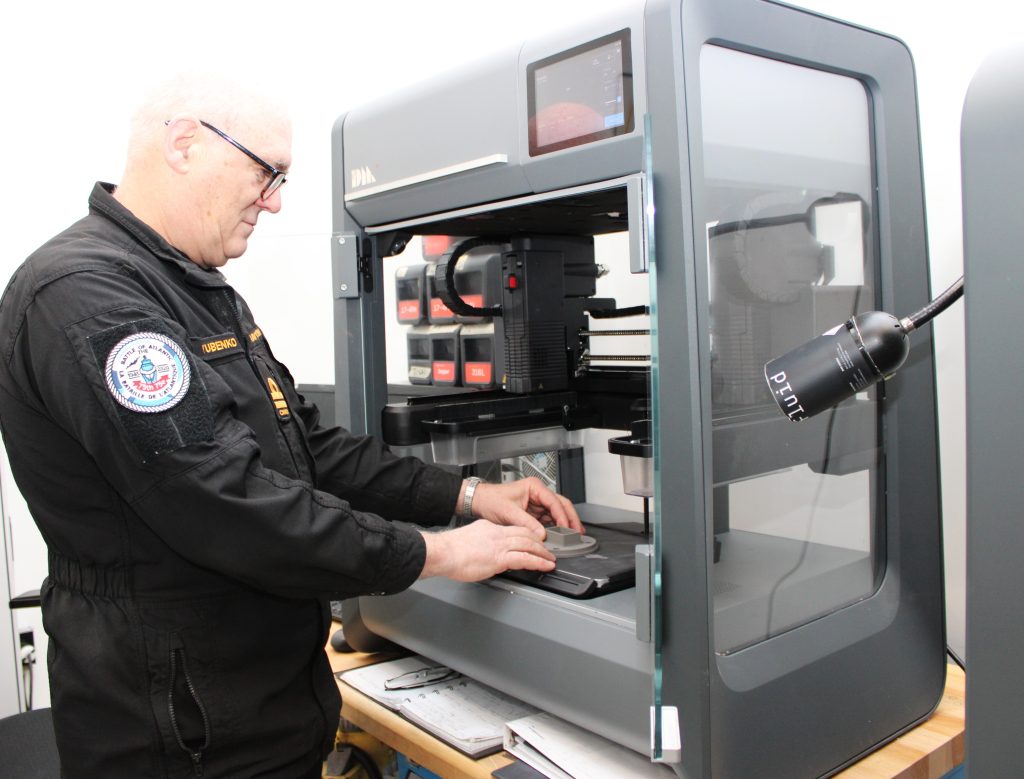
Two separate 3D printing labs currently operate at FMF Cape Scott: one focused on production work and another dedicated largely to research and development efforts led by Lieutenant(N) (Lt(N)) Oleg Lyubenko, the facility’s additive manufacturing engineer.
Lt(N) Lyubenko said the technology can help solve challenges caused by the age of the Royal Canadian Navy’s (RCN) Halifax-class frigates, where replacement parts can sometimes be difficult to source through traditional supply chains.
That capability extends beyond the dockyard. Deployed warships now carry compact mobile polymer 3D printers similar to those used in Lt(N) Lyubenko’s lab, allowing designs to be sent electronically and produced while at sea. Personnel can also modify designs remotely and share updated files back and forth as needed.
“It can be good for small components, like a gasket or a connecting piece, that is broken and needs to be replaced,” he explained. “Some of these simple parts are easy enough to print right on the ship.”
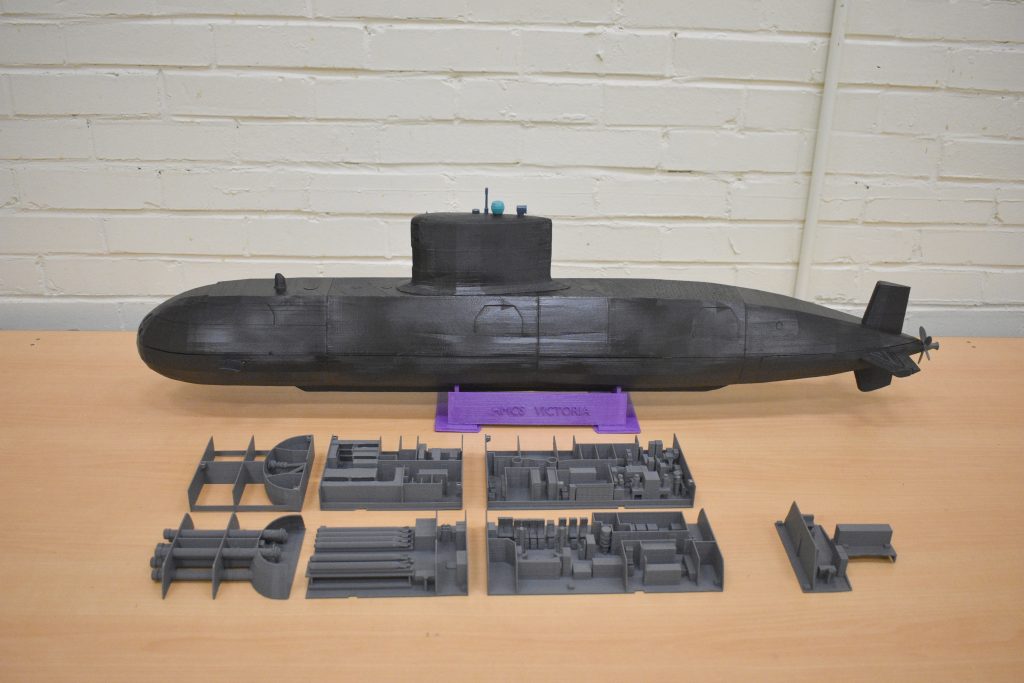
The technology has also become a valuable training tool. FMF Cape Scott has produced detailed ship and submarine models that can be disassembled “Lego-style” to reveal internal systems and layouts for educational purposes. Models of Arctic and Offshore Patrol Ships and the future Protecteur-class Joint Support Ships are among the projects currently supporting training efforts.
Beyond maintenance and training, additive manufacturing has also been used to support naval heritage initiatives, including the production of ship badges, bells, and commemorative items for local units and the Naval Museum of Halifax.
Further advances and uses for the technology in the naval setting are likely. Leaders at FMF Cape Scott are also keenly aware of ongoing defence-focused metal additive manufacturing research at Dalhousie University as a potential area of future interest. Such a connection could eventually help expand the RCN’s ability to manufacture specialized components domestically and reduce reliance on difficult-to-source parts.