
FORMATION IMAGING SERVICES
FMF Cape Scott conducts Link 22 Testing with French Ship Bretagne
By Gabrielle Brunette,
FMF Cape Scott
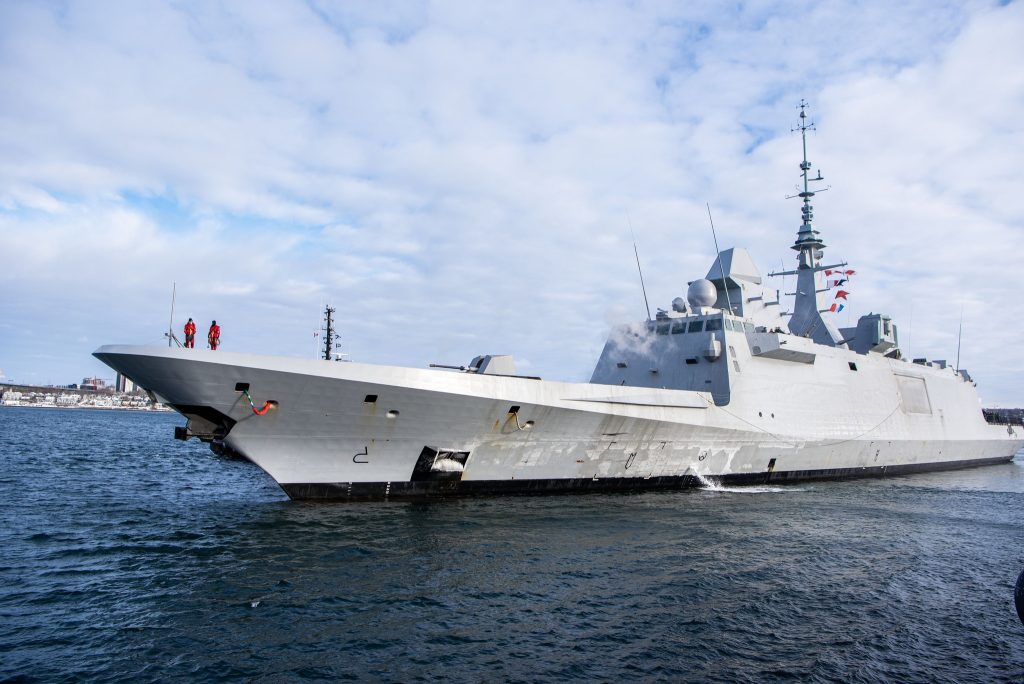
In February, Fleet Maintenance Facility (FMF) Cape Scott successfully collaborated with the Marine Nationale to conduct Link 22 (L‑22) testing with the French Ship (FS) Bretagne and a NH‑90 CAIMAN helicopter.
This marked the first time FMF Cape Scott has conducted Link 22 testing with an aircraft, and the third time it has worked with the French Navy. In 2020, FMF Cape Scott tested Link 22 with FS Normandie, completing the first successful over‑the‑air international L‑22 test. More recently, in 2024, testing was conducted between His Majesty’s Canadian Ship (HMCS) Charlottetown, FMF Cape Scott, a southern U.S. testing range, and two French ranges. During those tests, communication over thousands of nautical miles was achieved.
Link 22 is a NATO‑developed, secure, beyond‑line‑of‑sight tactical data link designed to allow allied military forces—air, surface, subsurface, and ground—to exchange tactical information reliably and securely across long distances.
“Tactical means everything we see on our radars, including friendly ships, suspect vessels, and more, is shared with them,” explained Chris Gilfoyle, Multi‑Link Engineering Facility Analyst at FMF Cape Scott. “Secure means the information is encrypted. There are no physical connections between ships and aircraft; the data is transmitted over radio.”
Link 22 uses high‑frequency communications, allowing it to operate in satellite‑denied environments, a capability that is becoming increasingly important given the current political climate.
While Link 22 has been under development for several years, it is still considered a relatively new and uncommon capability across allied fleets, which makes multinational testing more challenging.
“Normally, we only test to make sure our equipment is working. Our navies go out, and then they deal with whatever they encounter once they’re deployed,” said Gilfoyle. “It’s rare to have the opportunity to test with another navy.”
Designed to replace Link 11, Link 22 operates seamlessly alongside Link 16, another NATO system intended for shorter‑range communications. The new system has already been installed on all Canadian Patrol Frigates, with integration planned for the new River‑class ships and potential light‑version retrofits for Arctic vessels such as the Harry DeWolf‑class ships. The Royal Canadian Air Force is also preparing to adopt the system for some of its aircraft.
As allied fleets continue to modernize, FMF Cape Scott and the Royal Canadian Navy remain committed to supporting the integration and testing of Link 22, ensuring continued fleet readiness.