
HMCS Charlottetown conducts rare Demolition-at-Sea Training during Pacific Transit
By Lt(N) Rosa Gutierrez
One never knows what hazards may be encountered at sea. Although rare, ships can come into contact with abandoned vessels, drifting sea containers, or other floating debris that threaten safe navigation. In a scenario like this, one method of eliminating such a hazard is to conduct a demolition. Unfortunately, due to the nature of the task, opportunities to practice this capability at sea are few and far between.
However, Charlottetown found a rare training opportunity during its recent transit to Guam, United States. The ship had an inoperable Hammerhead Target drone on board that had reached the end of its service life. Rather than discarding it, the crew repurposed it as a realistic floating navigational hazard for the demolition exercise.
As with any operation involving explosives, safety was the top priority. Led by Petty Officer First Class (PO1) David Howard, Officer-in-Charge and a former senior demolitions instructor, the team spent considerable time planning the evolution, coordinating personnel, and mitigating risk.
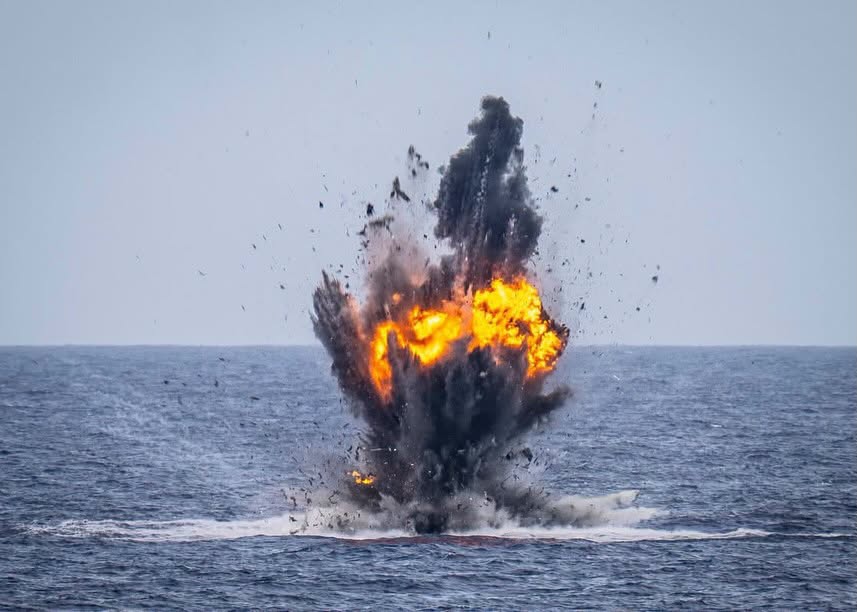
The team assembled and secured demolition charges before carefully launching the target. The ship also deployed two safety boats to ferry the payload 1,500 meters away from the ship, providing the redundancy needed to safely position the charge and leave the danger area. With the target in position, the demolition team received final authorization from Command before initiating a time-delayed firing system, allowing personnel to safely withdraw before the detonation.
The resulting blast, using 23 kilograms of C4 explosive, successfully destroyed the target exactly as planned. Beyond eliminating the floating hazard, the evolution offered sailors a chance to practice a skill rarely used.
“Opportunities like this don’t come along often, and when they do, we owe it to our sailors to train safely and realistically,” said Commander Jonathan Maurice, Charlottetown’s Commanding Officer. “This evolution showcased the professionalism of our team, their commitment to thorough planning and risk management, and their willingness to seize unique training opportunities that strengthen our operational readiness.”