
Admiral’s account of Navy’s efforts during First Gulf War gets a new edition
By Nathan Stone,
Trident Staff
The man who led Canada’s naval task group in the First Gulf War, Vice-Admiral (VAdm) (Retired) Duncan (Dusty) E. Miller, launched a new edition of his book on the actions of Canada’s Navy during the conflict.
The launch party was hosted by the Canadian Naval Memorial Trust, aboard His Majesty’s Canadian Ship (HMCS) Sackville on September 11.
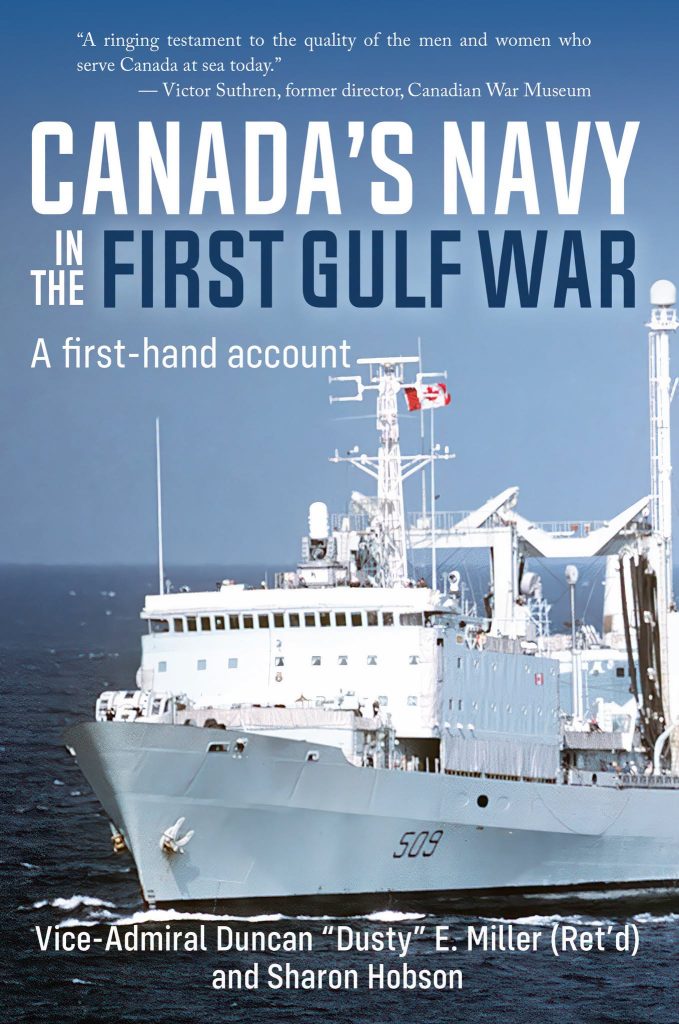
Canada’s Navy in the First Gulf War, co-written with Sharon Hobson, is a first-hand account of the Canadian-led naval operation during the 1990-91 conflict. Miller commanded the Canadian task group deployed to the Persian Gulf under Operation FRICTION. At the time, the service was known as Maritime Command; it was renamed the Royal Canadian Navy in 2011.
Originally released in 1995 under the title of The Persian Excursion, the book covers Canada’s role in the conflict from start to finish.
The new edition, published by Formac, includes an additional chapter exploring how the navy has evolved over the past 35 years.
During the launch, Miller recounted tales from the book, including the extraordinary effort required to prepare the ships for war. After Iraq invaded Kuwait in August 1990, Canada committed two warships and a supply vessel. Each of the ships required significant equipment upgrades.
“The Dockyard did two weeks’ worth of putting all this new equipment aboard in what would have been an eight-month job,” Miller said, even noting a final, last-minute trip to Canadian Tire for a missing part.
Once in the gulf, Miller and the naval task group oversaw the Combat Logistics Force, made up of about sixty ships from allied nations.
Miller said the book was written to let Canadians know how well their Navy (then known as Maritime Command, now as the Royal Canadian Navy) operates when it matters most. He recalled being urged to write it by the then Chief of Defence Staff, General John de Chastelain, upon his return from the Gulf. De Chastelain told him that leading a coalition force during wartime was something Canadians hadn’t done since the Second World War.
He highlighted the critical role of HMCS Protecteur, which refueled 70 allied ships during the war. The ship also carried 35 women, marking the first time Canada sent women into a war to serve in a front-line role.
In another story from the book, Miller described how HMCS Athabaskan “tiptoed” through a minefield to rescue the United States Ship (USS) Princeton after it struck a mine off Kuwait.
He also made mention of the support from home during the war, including free pizzas brought to the ships from a Halifax Greco Pizza location, and lobsters from Clearwater for Christmas. He noted the sailors voted to go to sea on Christmas Eve and Christmas Day because they felt safest there.
“The quality of the men and women sailors was amazing,” he said.
Canada’s Navy in the First Gulf War is now available for purchase. Miller will also deliver a presentation on the book at the Maritime Museum of the Atlantic on November 10.