
The Department of National Defence (DND) is building a Land-Based Test Facility on a portion of DND-owned land at Hartlen Point in Eastern Passage, Nova Scotia.
Frequently Asked Questions
↓ Public Update (January 19, 2026)
Community Information Bulletin
Construction timeline update
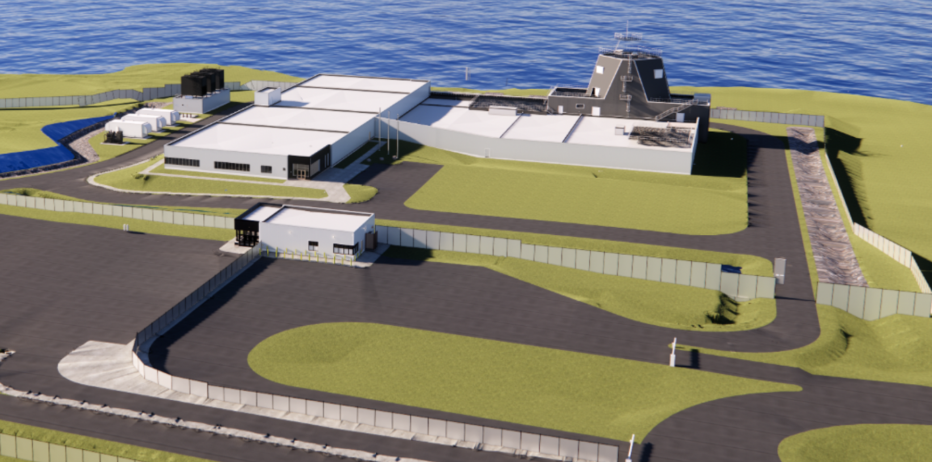
The next phase of construction of the River-class Destroyer Land-Based Test Facility (LBTF) started in November 2025 at Hartlen Point in Eastern Passage, Nova Scotia. Construction is expected to be complete in early 2028. This work includes building the facility and supporting infrastructure such as security fencing, parking lot, roads, and utilities. See the most recent rendering of the LBTF below (Figure 1) for reference. Although construction is expected to be complete in early 2028, timing is subject to change based on the progress of the design and construction processes. Updates will continue to be provided as new information is available. Timing is subject to change based on the progress of the design and construction processes.
Project footprint update
Note: The project footprint information below remains as it was originally presented in the January 2025 public update – no changes.
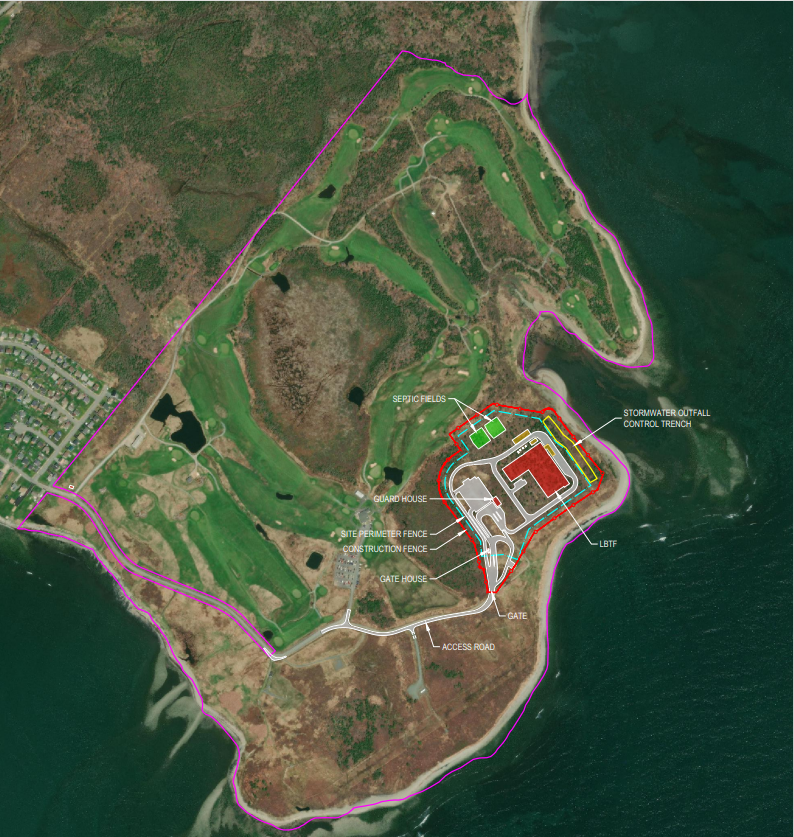
The project footprint includes the area within the future LBTF fence line, the roadway leading to the site, required clearance beyond the fence for security reasons, and a stormwater outfall control trench. The overall footprint (including clearance beyond the fence and the stormwater outfall control trench) is approximately 10 hectares. In addition to the main building (12,567 m2 total gross area across two floors plus a topside, with a footprint of approximately 9,100 m2), the site will include a 32 m2 gate house and a 271 m2 guard house. See the most recent site plan below (Figure 2) for reference.
Project footprint notes:
- The project design was done to minimize impacts to coastal wetland areas to the extent possible while also adhering to functional space and security requirements.
- The closest point of the main building to the ordinary high-water mark (OHWM) is 90.6 metres.
- The closest point of the permanent fence to the OHWM is 52.4 metres.
- A stormwater outfall control trench is a necessary environmental measure being constructed and it will be 28.5 metres from the OHWM on the eastern edge and 19.3 metres from the OHWM at the baseline of the slope.
- The current construction fence is closer to the OHWM than the permanent fence will be. This is to ensure public safety and keep an adequate distance from the active construction activities.
Coastal erosion and shoreline stability
Following DND’s original Environmental Effects Determination (EED) for the LBTF project, further studies were undertaken to better understand the coastal erosion processes on the shoreline of the project site, focusing in particular on the shoreline’s northeast and southeast segments. Following these studies, a concept design for shoreline protection that accounts for future sea level rise was prepared.
Before a detailed design for shoreline stability can be completed, an additional EED is required and is underway. As part of this process, DND invited the public to provide comments on the Canadian Impact Assessment Registry (CIAR) website. The posting was live and was open for public comment for 30 days, between January 15 and February 14, 2025. Public comments received during the public posting period have been taken into account and consultation is ongoing with government regulatory authorities before the report can be finalized.
The project team continues to work on determination of post-construction operational and security constraints, striving towards minimal impact to fishing, surfing, birding, golfing, hiking, and other land and water-based activities to the extent possible. As more information is available, it will be shared with the public.
What to expect during construction
- Main work hours are from Monday to Friday between 7 am and 5 pm. Exceptions may be made for after-hours work but will be limited.
- Public access and safety are a high priority. Members of the public may continue using the Hartlen Point property and accessing the shoreline in front of the construction site for recreational activities until further notice. Public access within the designated project area/construction zone is not permitted for the safety of community members and work crews.
- There is construction signage, construction fencing, and jersey barriers in place at Hartlen Point to delineate the construction zone perimeter. Access to the construction area is prohibited and monitored by commissionaires and roving active spotters for the safety of the work crews and community members. Members of the public are asked to adhere to all signage near the active site.
- A commissionaire is also posted 24/7 at the entrance to the access road for daytime safety when construction vehicles are coming and going and for the safety and security of the site after hours. The intent is to erect the permanent security fence in early 2026.
- There may be dust, noise, construction equipment traffic, and temporary closures to the site’s access road. The Department of National Defence is making every effort to reduce impacts on the community.
Review of pre-construction site preparation work
The first phase of site preparation, brush clearing and tree removal, occurred at Hartlen Point from early March to April 2023. Work took place within this period to avoid bird and bat breeding and migratory windows, as per the recommendation outlined in Canadian British Consulting Limited’s Bird and Bat Assessment report.
The second phase of site preparation began in April 2023 and is still underway, overlapping with the start of construction. Site preparation work completed to date includes laying gravel for roadway access to the building site and grading, extending municipal services and installing culverts. To maintain progress and efficiency while design continued, additional early work packages started in summer 2024. These included a civil package (excavation and backfilling ahead of laying foundation), and a concrete package (concrete footings, foundations, retaining walls, and elevator/stair shafts).
As part of the civil package, there was a stormwater trench built to collect runoff. The trench will release collected runoff slowly toward the adjacent shoreline. This was done to limit the need for additional stormwater infrastructure.
A soil characterization study has also been completed and results were used to prepare a soil management plan for the LBTF site. The study identified no widespread contamination and that the majority of the disturbed soil could be re-used on site. There is a small amount of contaminated soil from the area surrounding a de-commissioned antenna that will be disposed of offsite at a commercial treatment facility.
Radio Frequency licensing
The project team continues working to advance Radio Frequency (RF) licensing for this project, which is an Innovation, Science and Economic Development (ISED) Canada requirement. The RF licensing process includes public consultation by written notification as per ISED’s public consultation process. Further updates on this process will be communicated to members of the public when available; the RF licensing process has been initiated and is expected to be completed in 2028.
Project inquiries
Contact us! We welcome questions on this project at: CFBHalifaxPublicAffairs@forces.gc.ca
About the River-class Destroyer Project
The Government of Canada is procuring 15 new River-class Destroyer (RCD) ships for the Royal Canadian Navy (RCN). This new fleet will upgrade and replace the capabilities of the current Halifax-class frigates and retired Iroquois-class destroyers and is being built, tested, and trialed in Halifax, Nova Scotia. .
The first three ships will be named His Majesty’s Canadian Ships (HMCS) Fraser, Saint-Laurent, and Mackenzie. Further details on the project can be found here.
About the Land-Based Test Facility
To help bring the new River-class destroyers into service and support them throughout their lifecycle, the Department of National Defence (DND) is building a Land-Based Test Facility (LBTF) on a portion of DND-owned land at Hartlen Point in Eastern Passage, Nova Scotia. This project will test and integrate the ships’ capability systems before being installed on the actual vessels. The LBTF will be named HMCS Assiniboine after one of our most storied ship. The Assiniboine River does not flow into the ocean, a fitting name for this facility.
Canada is a maritime nation, and the LBTF is an important, one-of-a-kind facility that will foster innovation and support sustainable growth in Canada’s marine industry. During construction and operation, the LBTF will contribute to the economy and to jobs and growth in the region. It is estimated that more than 10,000 Canadian jobs will be created or maintained throughout the 25-year construction period of the RCD ships, and the LBTF project is expected to sustain almost 350 jobs in the Halifax region throughout the various construction phases. Once complete, the facility will accommodate 120 full-time staff, including members of the RCN, DND employees and contractors.
DND is committed to doing its part to leave a healthy environment for future generations of Canadians and to meet the targets set in the Greening Government Strategy and the Defence Climate and Sustainability Strategy. The LBTF project at Hartlen Point will also follow DND’s Green Building Directive which targets net-zero carbon emissions.
Project Schedule
| Design-Build procurement process launched | June 2021 |
| Design contract awarded to PCL Construction | September 2021 |
| First community engagement session | March 2022 |
| Second community engagement session | January 2023 |
| Completion of environmental and traffic studies | March 2023 |
| Building design | 2022 – 2025 |
| Building early works (site preparation) | 2023 – 2025 |
| Building construction | 2025 – 2028 |