
SEASPAN
New Offshore Oceanographic Science Vessel to serve in 2026
By Archana Cini,
The Lookout
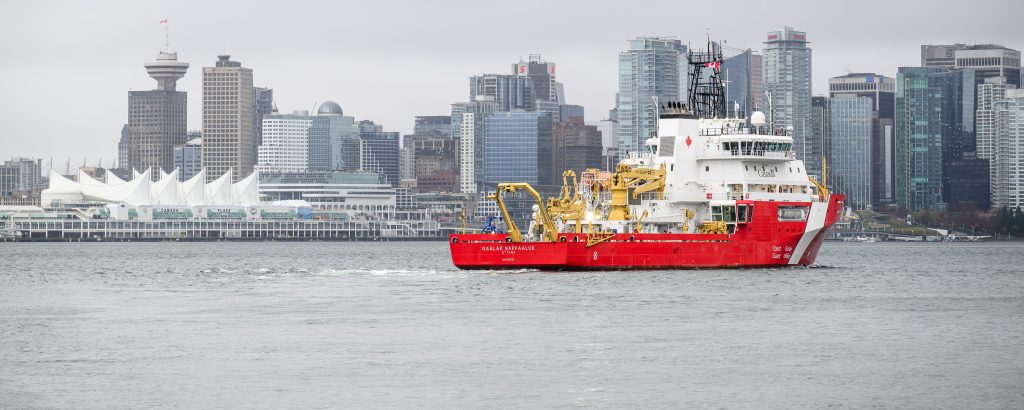
A major milestone in Canada’s shipbuilding program was reached this November when Seaspan Shipyards officially handed over the new Offshore Oceanographic Science Vessel (OOSV) Naalak Nappaaluk to the Canadian Coast Guard (CCG).
The delivery was celebrated in November at Seaspan’s North Vancouver Shipyard and marked the latest vessel completed under the Canadian National Shipbuilding Strategy (NSS). Constructed entirely in Vancouver by Seaspan ULC, Canadian Coast Guard Ship (CCGS) Naalak Nappaaluk is set to become the CCG’s largest purpose-built science vessel. Designed to support long-term oceanographic research on both the Atlantic and Arctic coasts, the ship brings a suite of specialized tools and technology to help answer Canada’s most pressing marine questions.
The Naalak Nappaaluk is set to replace the retired CCGS Hudson, serving as the primary ocean science platform on Canada’s East Coast for the next 30 years and beyond.
Onboard features include: dedicated laboratories; an ocean sampling room; a marine mammal observation station; and advanced monitoring systems that will allow scientists to gather data on ecosystems ranging from coastal shallows to deep-ocean environments. Beyond marine research, Naalak Nappaaluk is also equipped to assist with search and rescue, environmental response, and other urgent operations.
Notably, the vessel carries the name of Naalak Nappaaluk, an Inuit Elder from Kangiqsujuaq, Nunavik whose work helped preserve Inuit language and culture. Before his passing in 2010, Nappaaluk loved being on a boat at sea to hunt beluga with his unsay (harpoon). He was a leader, hunter, fisherman, midwife, storyteller, teacher, and harvesting advocate. He was also a consultant, astronomer, newsman, navigator, and meteorologist.
“He was just my father,” says Qiallak Nappaaluk, mayor of Kangiqsujuaq and son of Naalak Nappaaluk. “Everybody has a father. But when he was gone, I realized my father was really knowledgeable because he had been teaching us many things. But the most important was home and family. Sometimes we face good things, happiness, sadness, but we have to work together.” Naalak Nappaaluk’s legacy will now sail forward in a vessel built to deepen Canadian understanding of the waters around us.
As part of its reconciliation mandate, the CCG is also updating its vessel naming policy to incorporate more guidance from Inuit, First Nations, and Métis peoples.
“The CCG is deeply committed to its reconciliation journey,” said Nicole Elmy, CCG’s Executive Director of Indigenous Relations. “Of equal importance is the process by which names are selected and the opportunity for our staff and the public to learn about their significance,” she said. “We understand the power that names hold, that they can celebrate or be hurtful, and so we are approaching the naming of some of the new ships as an important, collaborative opportunity to work together with Indigenous Peoples.”
The name was selected in collaboration with the Inuit Tapiriit Kanatami (ITK) organization, reflecting the Government of Canada’s ongoing commitment to reconciliation and partnership with Indigenous Peoples. The Honourable Mélanie Joly, Minister of Industry, attended the acceptance ceremony on behalf of Minister of National Defence, The Honourable David J. McGuinty, formally accepting the vessel into federal service.
“The CCGS Naalak Nappaaluk is a powerful symbol of Canada’s industrial ambition and strategic vision. Through our National Shipbuilding Strategy (NSS), we are not only revitalizing our marine sector but also driving innovation, creating high-quality jobs, and reinforcing our sovereign research capabilities,” said Joly. “Built by Canadians, this vessel reflects our commitment to building a resilient industrial base, a competitive defence sector, and a future where Canadian expertise leads on the world stage.”
The vessel will now make the transit from Vancouver Shipyards through the Panama Canal to its home port at the Bedford Institute of Oceanography in Dartmouth, Nova Scotia, where it will enter service in 2026.